



hawaii
Why Bishop Museum works for toddler families
The Bishop Museum in Honolulu offers something most cultural institutions struggle to deliver: genuine Hawaiian heritage alongside spaces where a two-year-old can move, touch and make noise without apology. Spread across 14 acres in the Kalihi district, the museum balances its role as the state's premier repository of Polynesian artefacts with a practical understanding that young children learn by doing, not reading wall text.
The layout helps. Hawaiian Hall anchors the complex with three storeys of royal capes, carved gods and voyaging canoes, but toddler families typically spend most of their time in the Science Adventure Center, a separate building designed for interaction. Between the two sits open lawn—real grass, room to run, no ropes. On a island where many attractions are tightly programmed or require sitting still, that combination of substance and space makes the museum a reliable choice when you need both education and an outlet for toddler energy.
Plan for two to three hours if your child is under four. The grounds are pram-friendly, with lifts in the main buildings and a small café midway through. Check the official site for current opening hours and any special exhibit fees.
The Science Adventure Center: built for small hands
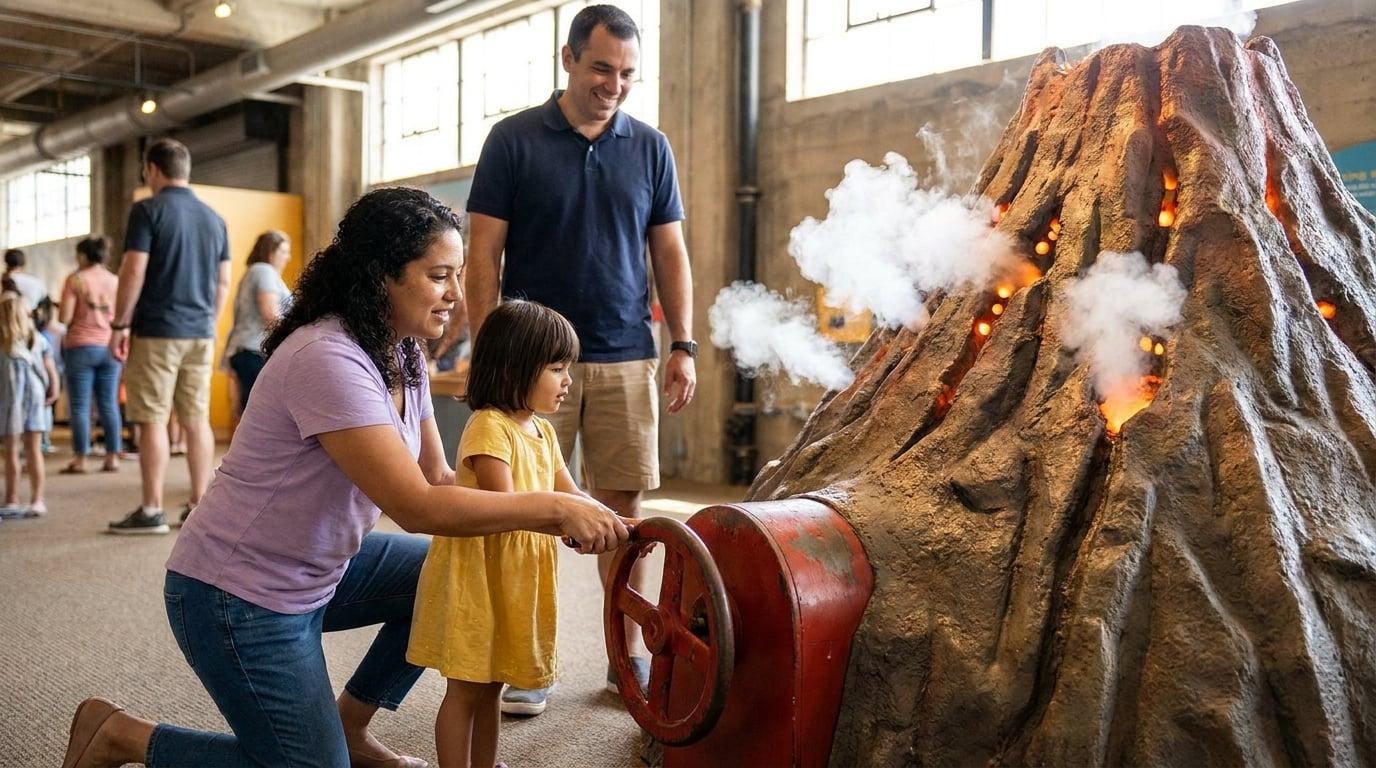
The Richard T. Mamiya Science Adventure Center is where toddlers find their footing. The signature piece is a walk-in model volcano that erupts every seven minutes with lights, sound and a puff of theatrical smoke. Your child can turn cranks to release gas, press buttons to trigger magma flows and watch how pressure builds before an eruption. The controls are low, chunky and designed to withstand enthusiastic handling.
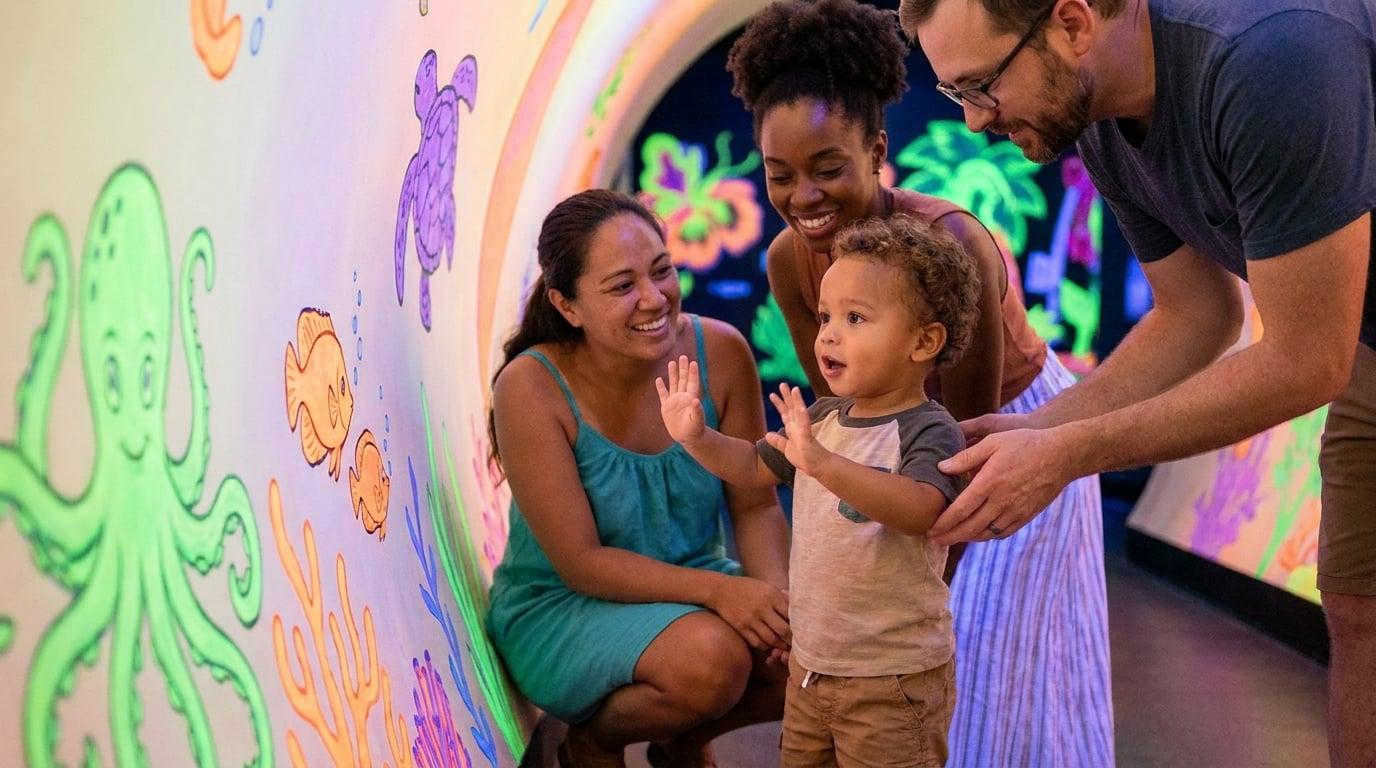
Adjacent to the volcano sits the Hawaiian Origins Tunnel, a black-lit corridor glowing with neon marine creatures and endemic species painted by local schoolchildren. Toddlers walk through slowly, pointing at fish and octopuses that seem to float in the dark. It is dim but not frightening, and short enough that even hesitant walkers make it through without being carried.
Scattered throughout the centre are touch-screen stations, a gravity well where you roll marbles to watch orbital mechanics, and an augmented-reality sandbox that lets children shape mountains and valleys while a projector overlays topographic lines in real time. Not every toddler will grasp the physics, but most enjoy the immediate cause-and-effect: dig a hole, watch blue water fill it; build a peak, see brown contour lines climb.
The lava demonstration in the Hot Spot Theater runs daily at noon. Staff heat actual basaltic rock to over 1,000 degrees Celsius in a basement furnace, then pour glowing molten lava onto a metal table while explaining how the Hawaiian island chain formed. The show lasts about 25 minutes. Toddlers are welcome, though some find the heat and brightness overwhelming; position yourself near the exit if your child is sensitive to loud environments or sudden sensory shifts.
[[image:1]]
Planetarium shows designed for short attention spans
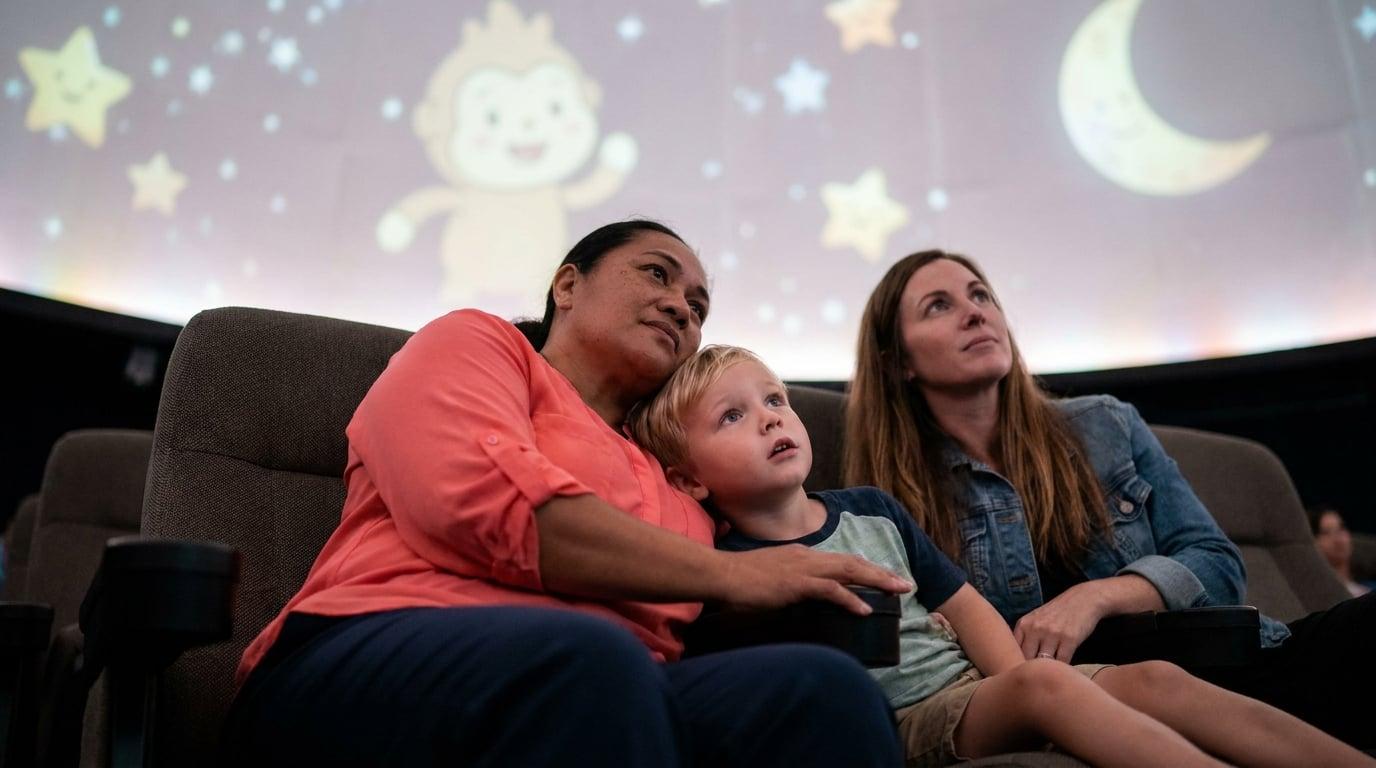
The J. Watumull Planetarium offers a programme called In My Backyard, designed specifically for children aged three to eight. It runs for roughly 20 minutes on Wednesday, Saturday and Sunday mornings at 10 a.m. The show features animated characters who sing, explore constellations and explain why the sky changes from day to night. The visuals are bright and the narration is simple, with none of the abstract cosmology that loses toddler audiences in adult planetarium programming.
Arrive 10 minutes early. The planetarium lobby has interactive light displays and a small hands-on area where children can manipulate shadows and experiment with colour mixing while you wait for the doors to open. Seating inside reclines, and the dome surrounds you; some toddlers find it magical, others disorienting. If your child resists the dark or enclosed spaces, you can leave without disrupting others—the exit is clearly marked and staff are used to families slipping out mid-show.
Other planetarium offerings focus on Polynesian wayfinding and deep-space imagery. These are visually stunning but slower-paced and aimed at older children and adults. Stick with In My Backyard if your child is under four; check the current schedule on the museum's official site, as show times occasionally shift for special events.
Hawaiian Hall: how much toddlers actually absorb
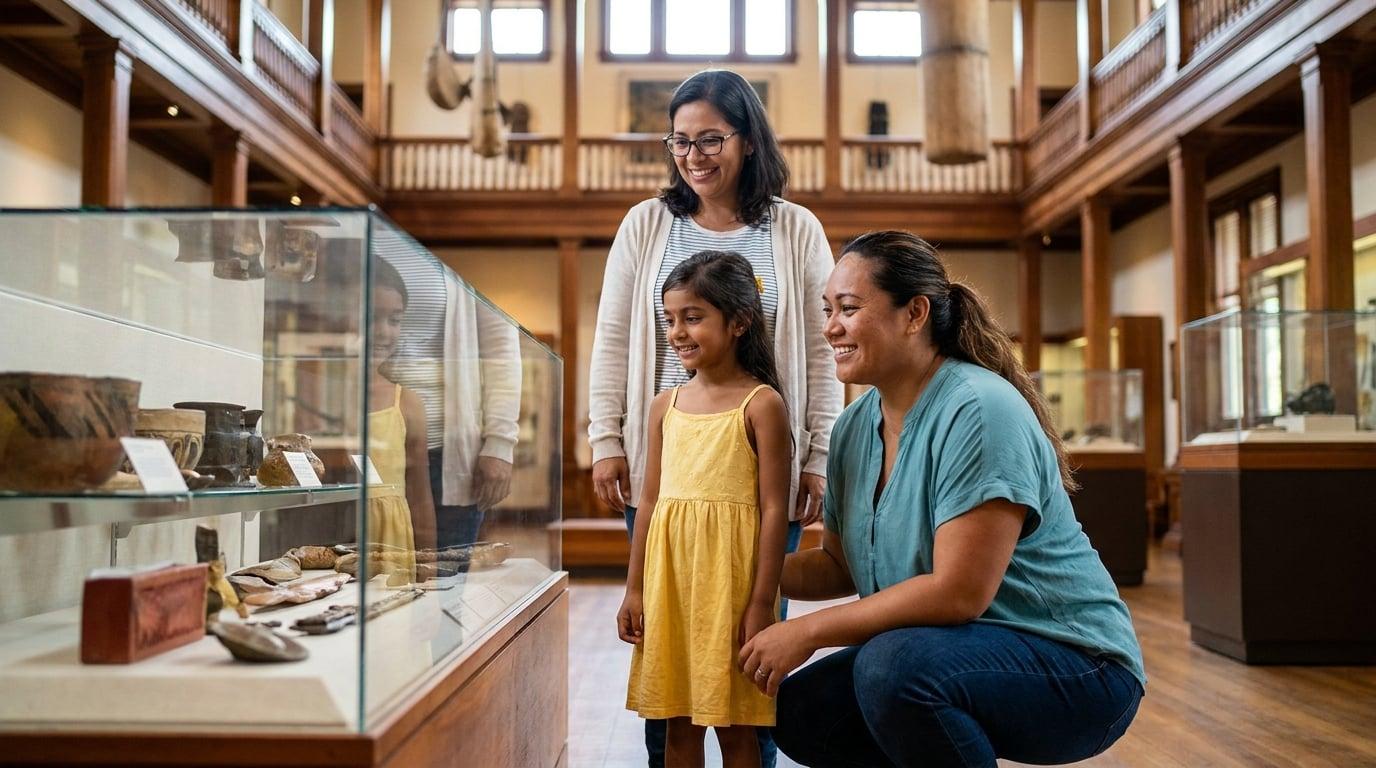
Hawaiian Hall is the museum's architectural and cultural centrepiece—a three-storey Romanesque stone building filled with feather cloaks, wooden temple figures, Duke Kahanamoku's surfboard and artefacts spanning a thousand years of Polynesian settlement. It is objectively impressive. It is also, for most toddlers, a place to move through quickly.
The hall is not interactive. Everything is behind glass or roped off, and the information is delivered through labels and audio guides. A few families with patient three-year-olds linger on the ground floor, where large objects—a full-size outrigger canoe, a towering carved deity—hold visual interest even without context. But if your toddler is in a running phase or resistant to "look, don't touch" environments, you will spend more energy managing behaviour than absorbing history.
That said, the space itself is worth a walk-through. The hall's open atrium rises three storeys, with balconies on each level and natural light filtering through high windows. The scale impresses young children even when the content does not. Some families use it as a cool, quiet interlude between more active exhibits, spending ten minutes on the main floor before moving on.
The museum offers a children's audio tour in English, Hawaiian, Japanese and Chinese, with short clips about specific objects like fishhooks, shells and the famous surfboard. Each segment runs just over a minute, which matches toddler attention spans better than the standard adult narration.
[[image:2]]
How a local nanny helps here
A museum visit with a toddler requires constant negotiation—when to push through one more exhibit, when to abandon the plan and head for open space, how to balance your interest in Hawaiian history with your child's need to climb something. A local nanny from The Travel Nanny brings an extra set of hands and, more importantly, familiarity with the museum's rhythms. She knows which interactive stations are worth the queue, where the quietest spots are when your toddler needs a sensory break, and how to time your visit around the lava demonstration and planetarium show without the day feeling forced. While she engages your child with the augmented sandbox or walks the glowing tunnel for the third time, you can spend 20 minutes in Hawaiian Hall at your own pace, absorbing the craftsmanship and historical narrative that toddler logistics usually prevent.
The grounds: where toddlers reset
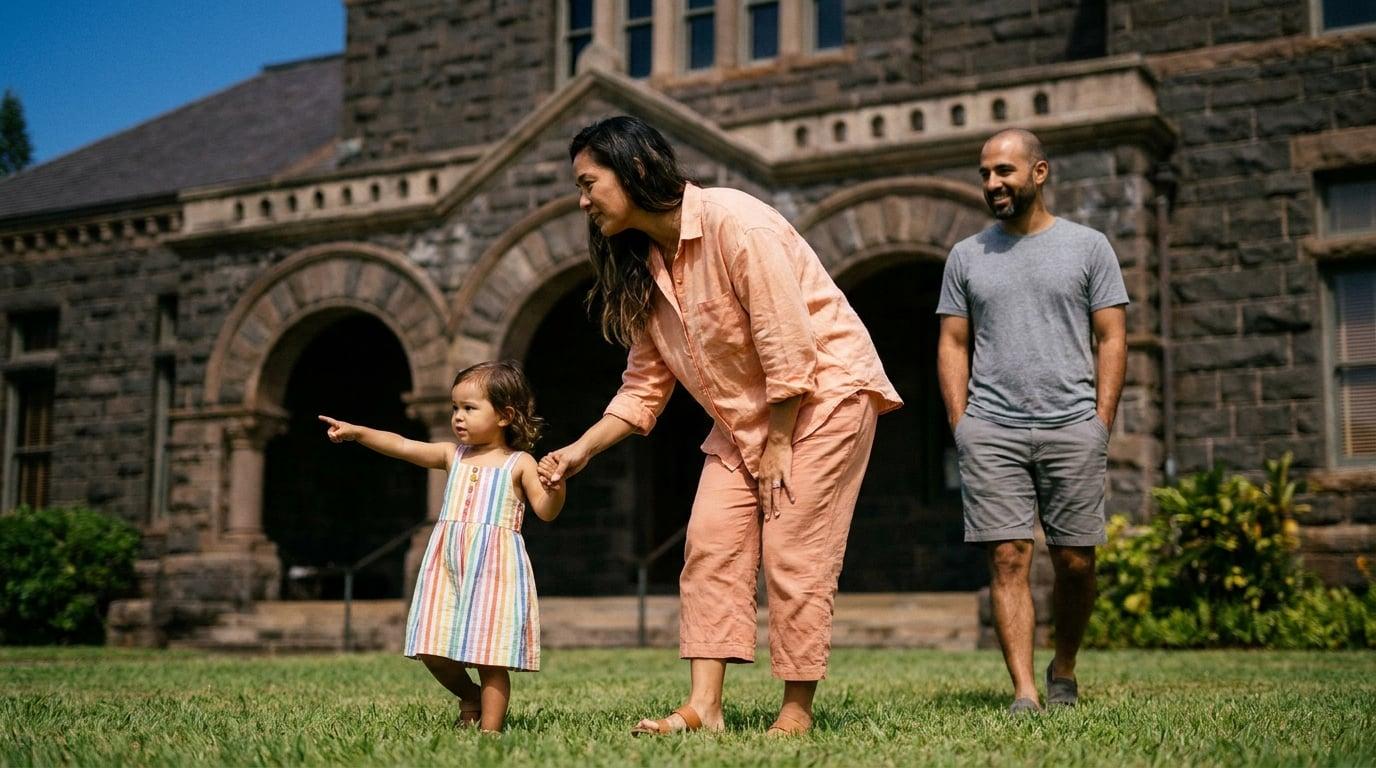
The outdoor spaces at Bishop Museum are what make a long visit possible with very young children. The Great Lawn is a broad, uninterrupted stretch of grass bordered by heritage buildings and shaded by mature trees. Toddlers can run in wide circles, practise walking on uneven ground or simply lie on their backs and watch clouds while you sit on a bench and finish your coffee.
Scattered around the campus are smaller courtyards, garden paths and a native Hawaiian plant garden called Nā Ulu Kaiwiʻula. The garden is not a formal toddler play area, but the winding paths and varied textures—ti leaves, taro patches, smooth stones—offer gentle sensory exploration for children who are past the stage of putting everything in their mouths.
The museum's café sits near the entrance and serves simple lunches, snacks and shaved ice. The outdoor seating overlooks the lawn, so you can eat while your toddler continues to move. Some families pack a picnic and use the lawn as a proper midday break, letting children decompress before attempting the planetarium or a second pass through the Science Center.
Because the grounds are large and the exhibits are spread across multiple buildings, the museum never feels as crowded or echo-prone as single-structure institutions. If your toddler has a meltdown near the volcano, you can step outside and regroup without a long walk past judgmental crowds.
[[image:3]]
What to skip and what to prioritise
Pacific Hall and the Castle Memorial Building host rotating exhibits on broader Polynesian cultures and travelling shows. These are often excellent, but rarely toddler-focused. Unless the current exhibit is explicitly interactive or features large animals, dinosaurs or vehicles, you can safely skip these spaces with children under four and not feel you have missed the museum's core offering.
Do prioritise the lava demonstration if your toddler tolerates heat and crowds. It is one of the few places in the world where you can see molten rock poured in a controlled setting, and the visceral experience—the glow, the smell, the radiant warmth—registers with young children in a way that static displays do not.
Also prioritise unstructured time on the lawn. Many families arrive with an ambitious checklist and then wonder why their toddler is melting down by 11 a.m. The museum's value for this age group is not in seeing everything, but in offering a environment where culture, science and space to move exist in the same place. Let your child dictate the pace, and treat the exhibits as options rather than obligations.
The museum is open daily from 9 a.m. to 5 p.m., with some holiday closures. Morning visits, especially midweek, are quieter. Weekends bring local families, which adds energy but also noise and queue times for popular interactive stations.
Practical checklist
- Arrive by 9:30 a.m. to see the Science Adventure Center before it fills
- Book the 10 a.m. In My Backyard planetarium show if visiting Wednesday, Saturday or Sunday
- Plan for the noon lava demonstration; arrive five minutes early for seating
- Bring a pram—the campus is large and pathways are smooth
- Pack sun hats and water; the walk between buildings is outdoors and Honolulu is warm year-round
- Use the Great Lawn as a reset point, not an afterthought
- Allocate 20 minutes maximum for Hawaiian Hall unless your toddler is unusually patient with static displays
- Check the official website for current admission fees and any additional charges for special exhibits or planetarium entry
- Wear shoes suitable for walking on grass and gravel paths
- Bring a light layer for air-conditioned buildings; the temperature contrast with outdoor Honolulu can be sharp for small children