



hawaii
The Polynesian Cultural Center in Laie spreads across forty-two acres of the North Shore, and the question most parents ask is whether preschoolers will stay engaged for a full afternoon—or melt down halfway through. The answer depends less on your child's temperament than on how you sequence the six island villages, when you catch the canoe pageant, and whether you commit to the evening show that finishes well past most three-year-olds' usual lights-out.
The centre opens at noon and village activities run until half past five. <cite index="20-2,20-4">The evening show starts at 7:15 pm and runs until 8:35 pm</cite>, which puts you back at your accommodation closer to ten if you're staying in Waikiki. For families with preschoolers, that timeline requires either an in-car nap on the drive north or a willingness to skip the show entirely and treat this as a daytime-only visit. Both approaches work; neither is wrong.
The villages that hold preschool attention longest
<cite index="5-6">Six island villages—Hawaiʻi, Sāmoa, Tonga, Fiji, Aotearoa, and Tahiti—each feature authentic architecture and daily cultural presentations</cite>. Not all villages land equally well with the under-fives.
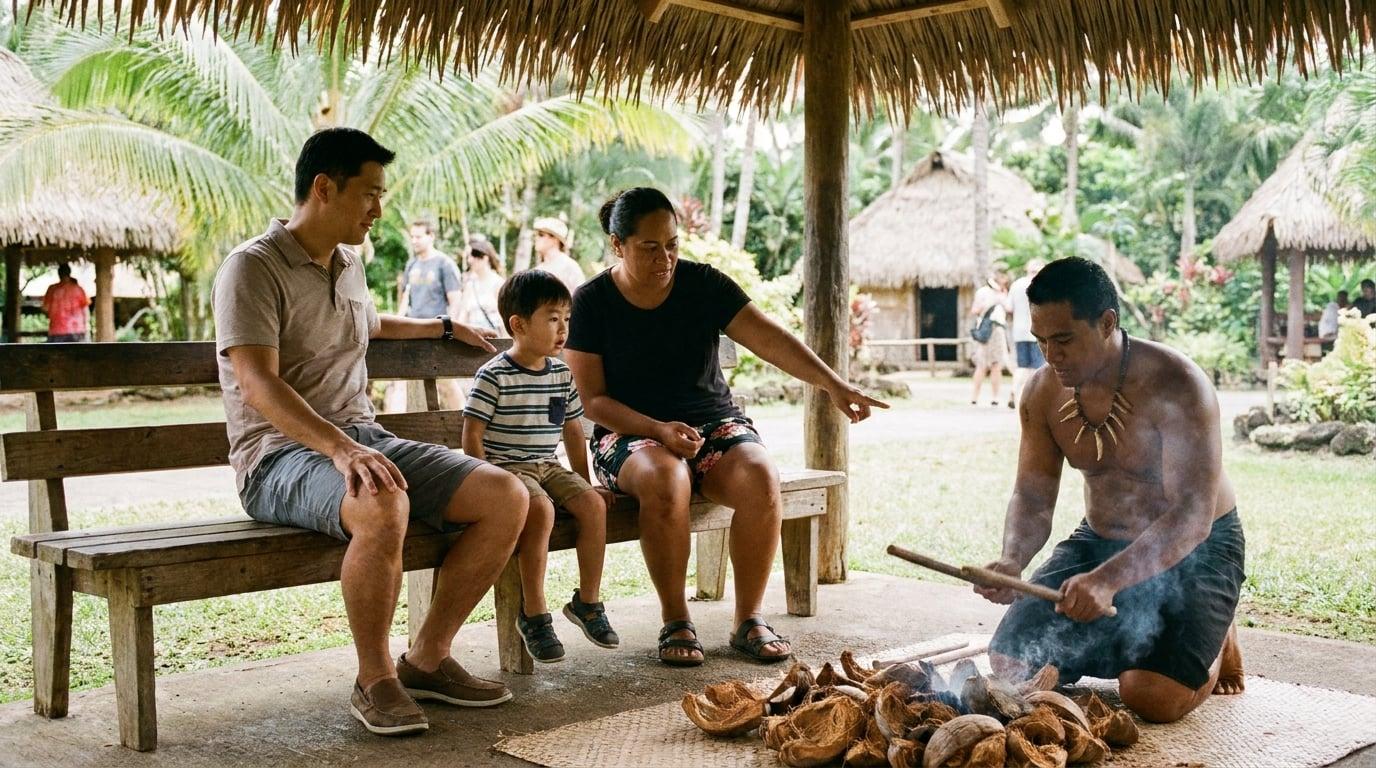
Samoa consistently wins with preschoolers. The fire-making demonstration uses coconut husk and stone, the movements are big and the presenter's energy is high. Even toddlers who wander during quieter moments will stop and stare when the friction catches. The village also offers coconut-cracking demonstrations and the chance to see someone shimmy forty feet up a palm trunk, both visceral enough to hold a three-year-old's gaze.
Tonga runs a close second. <cite index="39-8">Drumming exhibitions get everyone laughing and participating</cite>, and the beats are simple enough that small hands can join in without feeling lost. Spear-throwing happens here too, though the supervised version for young children involves foam-tipped spears and very short distances. It still counts as a win.
The Aotearoa village offers haka demonstrations and poi balls. <cite index="39-7">Families can learn basic haka moves and try poi balls, understanding their significance in Māori culture</cite>. The poi balls—soft weights on strings that you swing in patterns—work well for children with decent hand-eye coordination, typically four and up. Younger preschoolers may watch rather than participate, but the haka's stomping and chanting usually pulls them in.
Hawaii and Tahiti tend toward weaving, lei-making and gentler demonstrations. These suit children who enjoy sitting still with their hands busy, but they're slower-paced and easier to skip if attention spans are fraying. Fiji's presentations mix ceremony and storytelling; some families find the tone captivating, others report their preschoolers drifting.
The practical move is to start with Samoa or Tonga, lock in that early engagement, then hop between villages based on your child's energy rather than trying to see all six in order. <cite index="30-9,30-10">Cultural presentations begin across all six islands at 12:30 pm, and the islands open for hands-on activities at the same time</cite>. The schedule repeats throughout the afternoon, so if you miss one Samoan fire-starting session, another follows within the hour.
[[image:1]]
How the canoe rides actually work
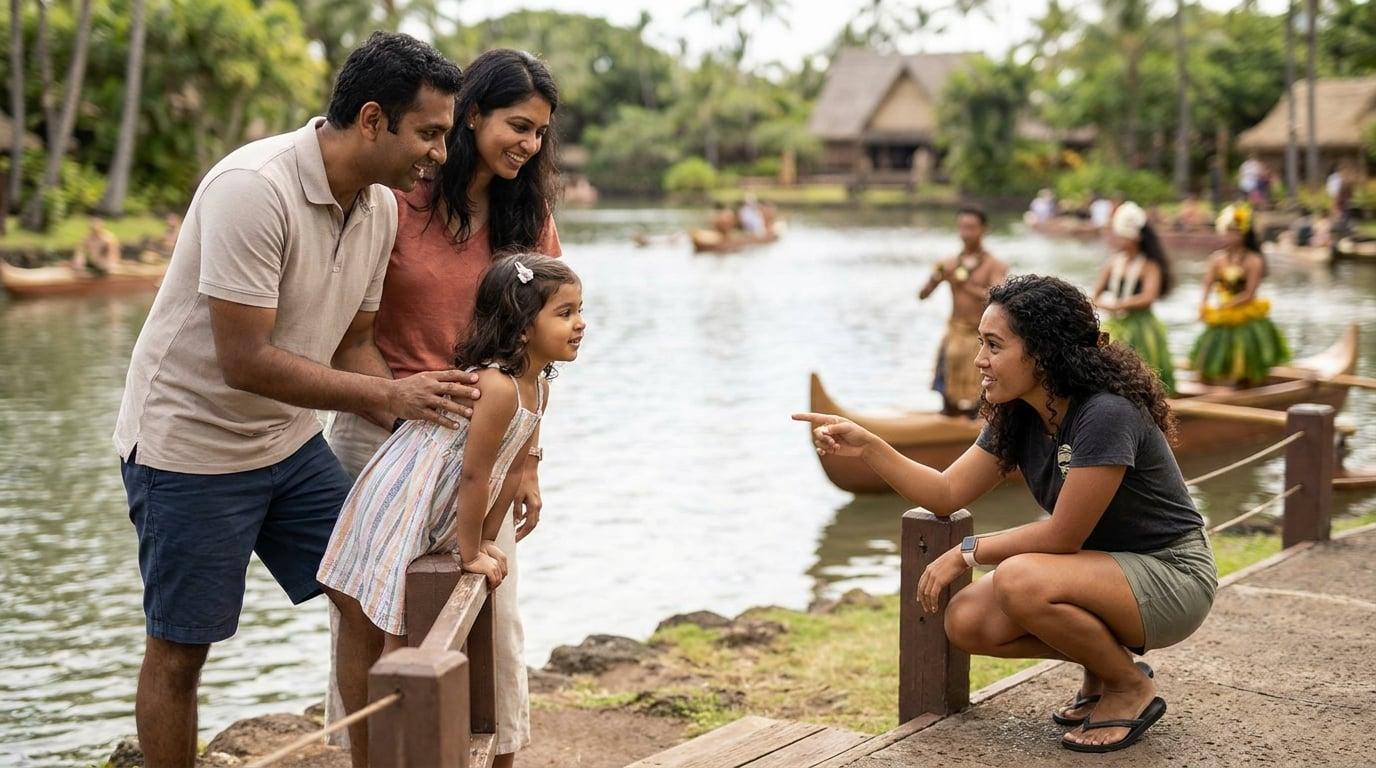
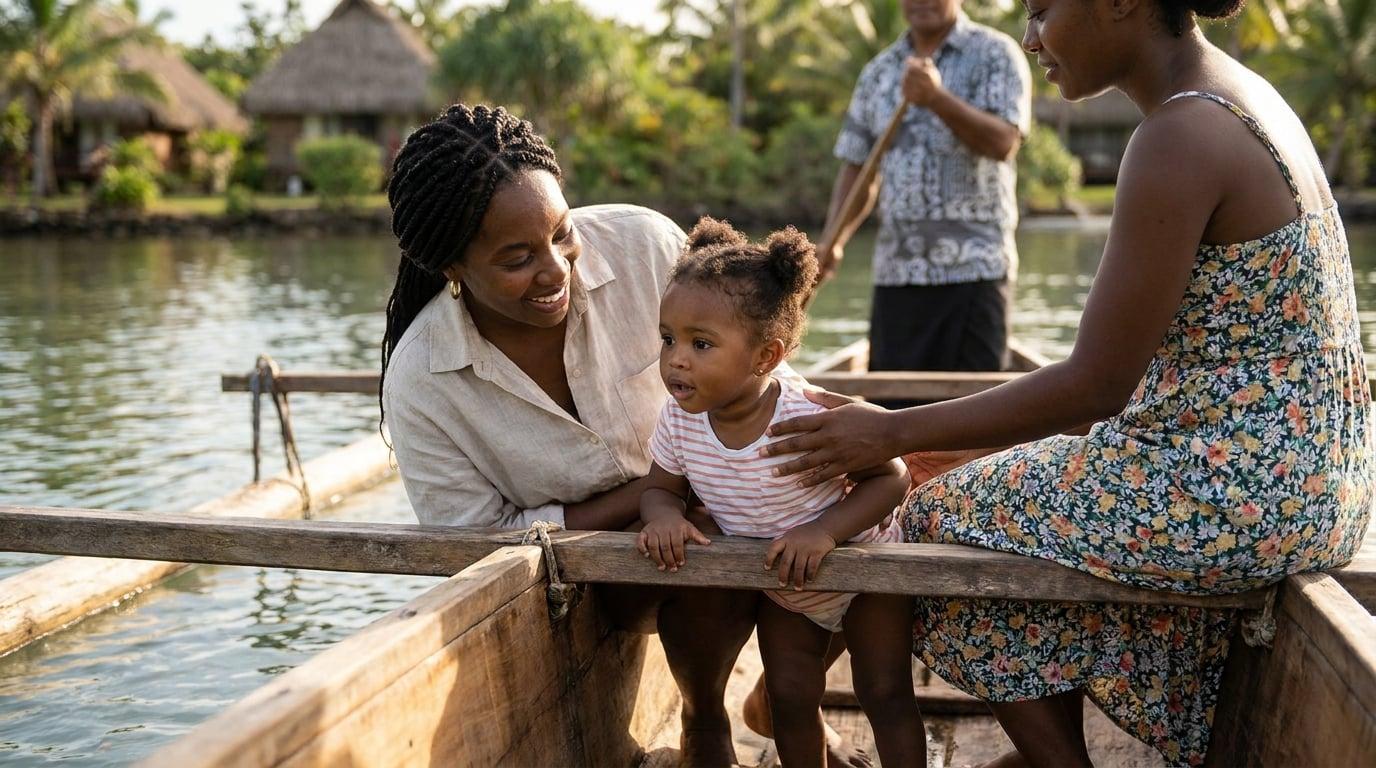
<cite index="40-1,40-6,40-7">The canoe ride along the Center's freshwater lagoon is guided by cultural presenters and offers a peaceful journey through the heart of the Island Villages</cite>. This isn't a theme-park flume; it's a flat, slow drift on a wide canal with a guide who poles the canoe and narrates bits of Polynesian navigation history.
For preschoolers, the appeal is almost entirely the fact that they're on a boat. The educational layer will sail past most under-fives, but the gentle motion and the novelty of floating between villages keeps them settled for ten to fifteen minutes. It's also a tactical rest—parents can sit, children stay contained, and everyone gets a break from walking.
The canoe boarding area sits near the Tonga village. <cite index="14-10,14-11">Canoe rides let you breathe in the beauty of the lush lagoon as you glide through the entire length of the Cultural Center, with fun and factual tidbits delivered by your canoe host at no charge</cite>. Queues are shortest mid-afternoon, after the canoe pageant but before the final village activities wind down. If your child needs a reset, this is when to use it.
The canoe pageant—called Huki: A Canoe Celebration—is a separate event. <cite index="31-1">It runs from 12:40 pm to 1:00 pm</cite>. <cite index="17-2">The lagoon hosts a parade of canoes that showcase the signature dances of each Polynesian culture</cite>. Dancers perform on moving double-hulled canoes, and the whole production floats past viewing areas along the water.
Preschoolers generally love this. The pageant doesn't require them to sit through a full theatre show; they can stand, point, move along the lagoon edge and still see everything. The music is loud, the costumes are bright, and the fact that people are dancing on boats registers as inherently surprising. <cite index="1-6">The afternoon canoe celebration keeps toddlers engaged without needing them to sit still for long</cite>.
Arrive at the lagoon by quarter past twelve to claim a spot near the water. The pageant is one of the most popular events of the day, and sightlines matter when you're holding a toddler on your hip.
Hands-on activities that don't require sitting still
<cite index="8-1,8-2">Children are actively welcomed into demonstrations—learning to pound poi, throw spears, play Fijian music, and weave palm leaves. The interactive nature of the villages means kids are engaged and active rather than passive spectators</cite>.
The activities that work best for preschoolers are the ones that produce immediate, visible results. Pounding poi in the Hawaiian village lets them smash something with a stone tool under supervision—always popular. Stamping patterns onto kapa cloth gives them a finished product they can see. Throwing a spear, even a safe one over a short distance, feels like an accomplishment.
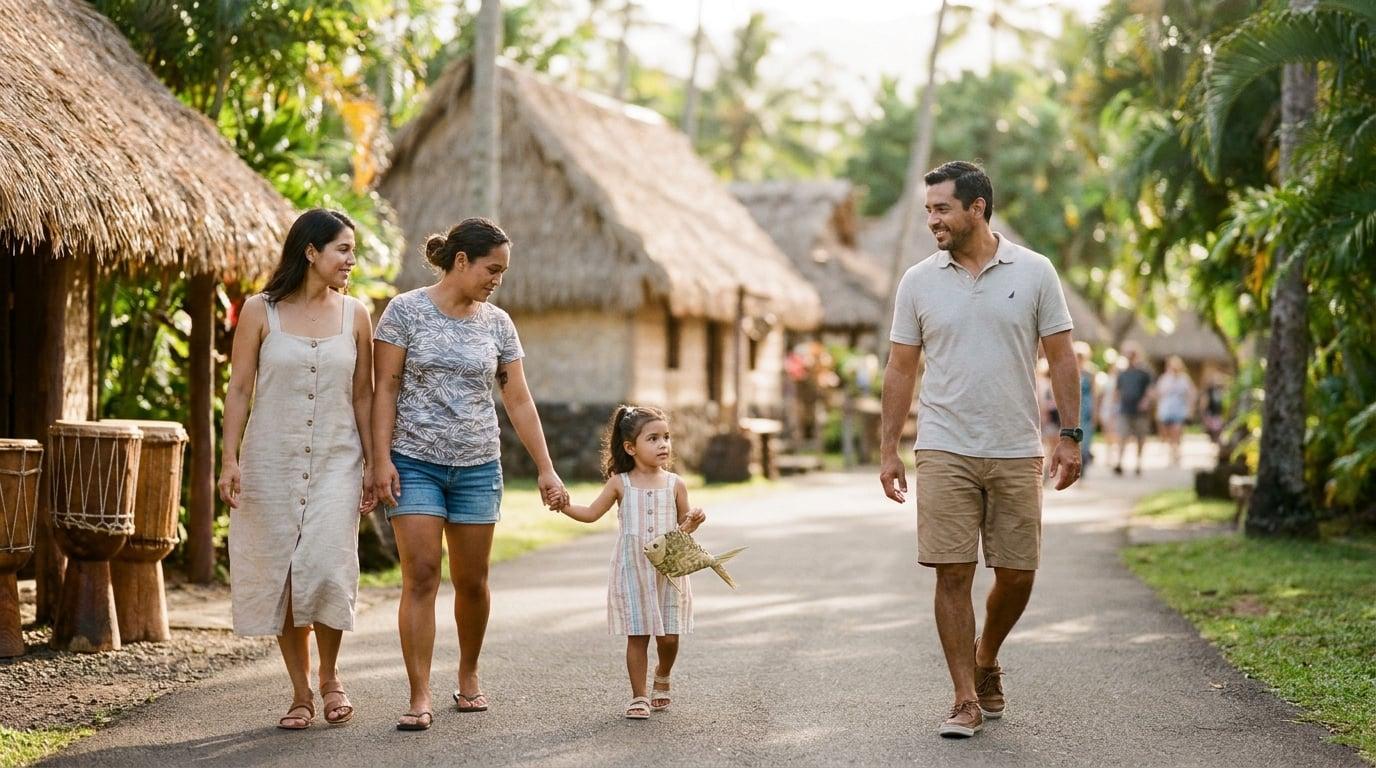
Weaving and instrument-playing sit at the other end. Some four- and five-year-olds will happily weave a small fish from coconut fronds and carry it around all day. Others lose interest after thirty seconds. The Fijian bamboo instruments are simple enough that most preschoolers can make a sound, which counts as a win, but don't expect a melody.
The temporary Samoan tattoos—applied with a stamp and non-toxic ink—are wildly popular with some children and entirely uninteresting to others. If your preschooler likes stickers, they'll probably like this. If they hate having things on their skin, skip it.
Each village runs its hands-on activities on a rolling basis throughout the afternoon, so you're not locked into a specific time. If your child wants to try drumming in Tonga twice, you can circle back. If they're done after one village, you can sit in the shade near the lagoon and let them watch the water.
[[image:2]]
Whether the evening show works for early bedtimes
Hā: Breath of Life is the centre's flagship production. <cite index="26-11,26-12">The elaborate amphitheater show features over 100 native Polynesian performers backed by stunning special effects, animation and surround sound. The show tells the story of a chief named Mana and his beloved wife Lani in a saga of love, family, birth, death, tragedy and triumph, all punctuated by cultural dance, music and a fire knife performance</cite>.
It's also eighty minutes long, starts at 7:15 in the evening, and asks preschoolers to sit in a dark theatre after a full afternoon of walking between villages. For many families with under-fives, that's a bridge too far.
The show itself is visually spectacular—fire dancing, waterfall projections, dramatic lighting—and the production values are high. Children who can sit through a full animated film at the cinema and who aren't yet in bed by half past seven will likely stay engaged. The Pacific Theater has good sightlines, and <cite index="41-15">the theater provides easy access to exits and restrooms, making it convenient for parents with infants and toddlers</cite>.
But if your preschooler's usual bedtime is seven o'clock, or if they've already been awake and active since noon, the show becomes a gamble. Some families report their three-year-olds watching the first twenty minutes with wide eyes, then falling asleep in their lap. Others say their child grew restless halfway through and they spent the second half standing in the back near the exit.
The centre offers packages with and without the evening show. <cite index="8-13">The village-only package costs $94.95 for adults and $75.96 for children</cite>. If you're unsure whether your preschooler will last, the safer bet is to book villages only, leave by six, and return for the show on a future visit when they're older.
If you do commit to the full day, the luau or buffet dinner runs between the village closing time and the evening show. That meal break gives preschoolers a chance to sit, eat, and recharge before the performance. It won't replace a nap, but it helps. <cite index="31-15">The last round of activities concludes by 5:30 pm to give everyone plenty of time to relax and enjoy the lūʻau, the buffet, or other food options before the show comes on stage at 7:30 pm</cite>.
How a local nanny helps here
A full afternoon at the Polynesian Cultural Center with preschoolers means juggling village schedules, canoe times, snack breaks and the inevitable "I'm tired, carry me" moments. Having a local nanny who knows the site means one adult can take an older sibling to the spear-throwing in Tonga while the other stays with a toddler who needs a slower pace near the Hawaiian village. When the canoe pageant starts at 12:40, your nanny can hold your spot along the lagoon while you finish up at another village, so no one misses it. If you're attempting the evening show, she can walk a restless preschooler outside for a break and bring them back in without the whole family losing their seats. The Travel Nanny matches visiting families with local caregivers across Hawaii who understand how to move through busy cultural sites without the stress of doing it alone.
[[image:3]]
Practical details that make the day smoother
The centre is located in Laie on Oahu's North Shore, about an hour's drive from Waikiki depending on traffic. <cite index="12-1,12-2">The Polynesian Cultural Center is open Monday, Tuesday, Thursday, Friday and Saturday, and closed Sundays and Wednesdays</cite>. Check the official site for any seasonal variations or holiday closures before you drive up.
Parking is free on-site. The paths throughout the villages are paved and stroller-friendly, though the crowds during the canoe pageant can make a pushchair awkward. <cite index="2-8">Children under 3 enter for free with a paying adult</cite>, and discounted pricing applies for ages four to eleven.
Bring refillable water bottles; the North Shore is warm and the villages offer limited shade in some areas. Snack stations appear throughout the site, but preschooler-friendly options are hit-and-miss, so pack your own if your child is particular. Sunscreen, hats and a change of clothes for any child prone to water play near the lagoon are all worth having in the bag.
If your preschooler still naps, the morning drive from Waikiki is your best chance. Arriving at noon when the centre opens means you catch the canoe pageant at 12:40, hit two or three high-energy villages in the early afternoon, take a canoe ride as a rest, then decide by four o'clock whether you're staying for dinner and the show or heading back to your accommodation before the evening rush.
The centre runs on a relaxed schedule—you're not locked into a rigid tour, and no one will chase you if you spend an hour in Samoa and skip Fiji entirely. For preschoolers, that flexibility is the whole point. Follow their energy, not the map.
Checklist: Polynesian Cultural Center with preschoolers
- Arrive by noon to catch the 12:40 canoe pageant along the lagoon
- Start with Samoa or Tonga for high-energy demonstrations that hold young attention
- Use the canoe ride as a mid-afternoon rest when legs are tired
- Book the village-only package if your preschooler's bedtime is before 8 pm
- Pack snacks, water, sunscreen and a change of clothes for lagoon splashing
- Check the official site for current opening days—closed Sundays and Wednesdays
- Plan for free parking on-site and paved, stroller-friendly paths
- Let your preschooler's energy dictate the route; you don't need to see all six villages
- If attempting the evening show, use the dinner break to let them recharge
- Consider leaving by 6 pm and returning for the show when they're older